
Medical Dermatology
A full skin examination, with time to do it properly.
A skin check is short, straightforward and the single most useful thing most adults can do about skin cancer. Found early, most skin cancers are highly treatable.
Overview
Understanding skin cancer screening
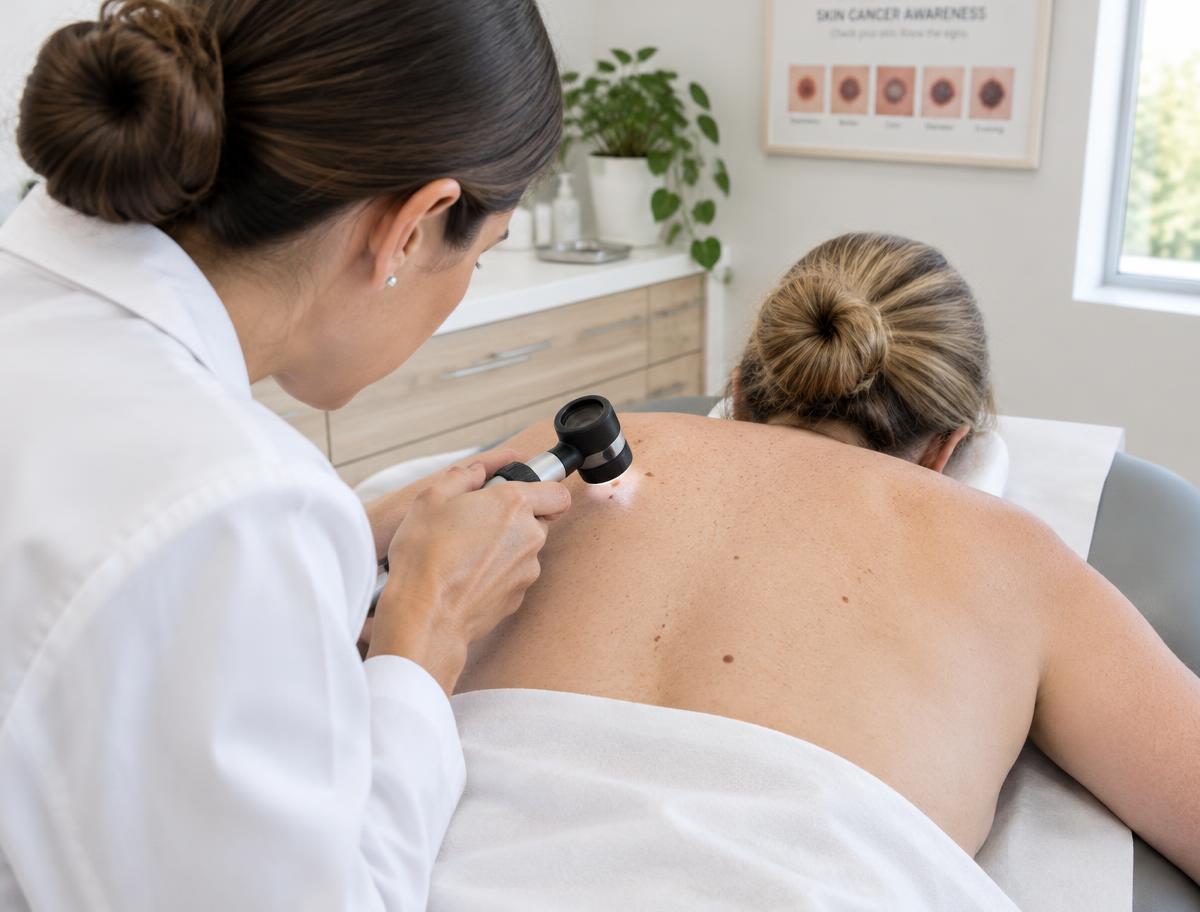
A skin cancer screening is a systematic examination of the skin, performed with good lighting and a dermatoscope, looking for basal cell carcinoma, squamous cell carcinoma, melanoma, precancerous actinic keratoses and other growths.
Skin cancer detection is deeply personal for Dr. Gaul. Between her first and second years of medical school, she identified a melanoma on her father during a visit home; he credits that diagnosis with saving his life.
In a region where people spend so much time outdoors and at elevation, regular skin examination is not a formality. It changes outcomes.
Signs
What you might notice
- A new growth, or one that is changing in size, shape or color
- A mole that looks different from your others
- A sore that will not heal, or that heals and returns
- A pearly, pink or scaly patch that bleeds easily
- A dark streak under a nail, or a spot on the palm or sole
- Any spot that itches, bleeds or simply concerns you
Care
How we treat it
Biopsy. A brief in-office procedure to obtain tissue for pathologic diagnosis.
Mohs micrographic surgery. Staged removal with same-day microscopic margin evaluation, generally for cancers on the face, ears, hands and other functionally or cosmetically sensitive sites.
Surgical excision. Removal with a margin of surrounding skin, with pathology review.
Field treatment. Topical or destructive treatment for actinic keratoses and sun-damaged areas.
Prevention and surveillance. A screening interval appropriate to your risk, plus practical sun-protection guidance.
Evaluation
How it’s diagnosed
You will change into a gown so the skin can be examined thoroughly, including the scalp, behind the ears, between the toes and the nails. Please arrive without makeup or tinted sunscreen, and with nail polish removed if possible.
Suspicious lesions are examined with a dermatoscope. If a lesion needs pathology, a small biopsy is performed at the same visit using local anesthetic. Biopsy results are typically available within 2 weeks.
If a skin cancer is confirmed, Dr. Gaul reviews the type, what it means and the treatment options — including Mohs surgery, excision and non-surgical approaches — before anything is scheduled.
This page is general education and is not medical advice, diagnosis or treatment, and it does not create a physician–patient relationship. Individual circumstances differ; please discuss your own skin with a qualified clinician. If you are having a medical emergency, call 911.
Questions
Frequently asked
It depends on your history. Many adults with average risk are seen annually; people with a history of skin cancer or numerous atypical moles are often seen more frequently. We will recommend an interval for you.
Please do, at the start of the visit. Your observation of change over time is information we do not otherwise have.
Medicare and most insurers specifically exclude dermatology from preventive billing codes, so skin examinations are billed as specialist evaluation and management visits. This is consistent across dermatology practices.

Let’s take care of your skin.
Whether something has changed, something has been bothering you for years, or you simply want expert guidance on keeping your skin healthy, we’re here to help.