
Medical Dermatology
Hair loss has causes. Start by finding yours.
Thinning hair is common and genuinely frustrating. It also has many different causes, and the right treatment depends entirely on which one you have.
Overview
Understanding hair loss
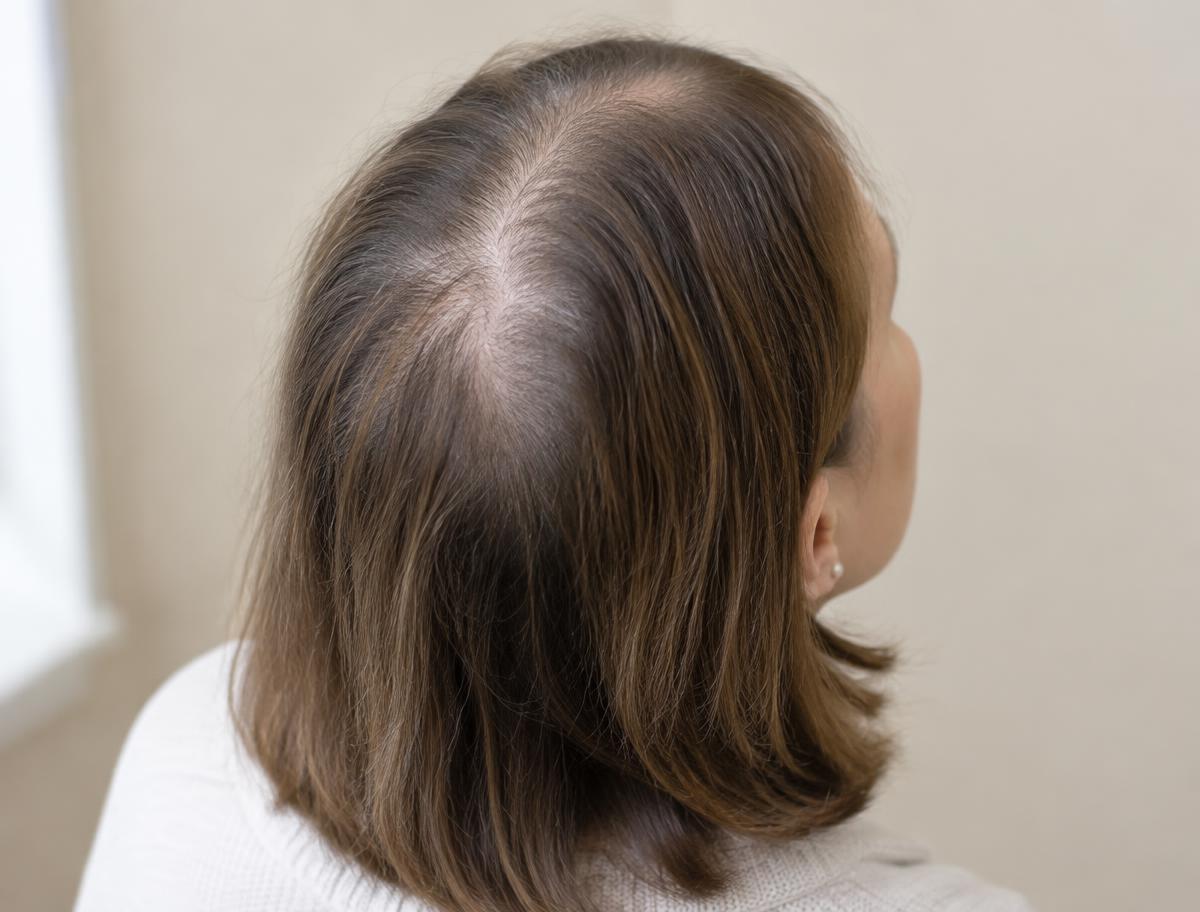
Hair loss can be hormonal and hereditary, triggered by illness, stress, surgery, weight loss or medication, driven by inflammation and scarring, or caused by a scalp condition or nutritional issue. Some types are reversible; some are not, though progression can often be slowed.
Two patterns account for most cases: androgenetic alopecia, meaning hormonal and age-related thinning, and telogen effluvium, meaning a shedding phase that follows a physiologic stress. Rapid weight loss, including on GLP-1 medications, is an increasingly common trigger.
Scarring forms of hair loss behave differently and are time-sensitive, because follicles that are lost cannot be recovered. That is the main reason not to wait and see for too long.
Signs
What you might notice
- Gradual widening of the part or thinning at the crown
- A receding frontal hairline
- Noticeably increased shedding in the shower or on the pillow
- Round patches of complete hair loss
- Itching, burning, tenderness, scaling or visible scalp changes
- Loss of the hairline with smooth, shiny scalp, which suggests a scarring process
Care
How we treat it
Topical therapy. Minoxidil, ketoconazole, tretinoin, topical anti-inflammatories and topical JAK inhibitors, depending on diagnosis.
Oral medication. Minoxidil, spironolactone, finasteride or dutasteride, JAK inhibitors and anti-inflammatory medication for selected diagnoses.
In-office procedures. Microneedling with platelet-rich plasma or exosomes, corticosteroid injections and low-level light therapy.
Supplements and products. Honest guidance on what has evidence behind it and what does not, so you are not spending money on hope.
Workup. Laboratory evaluation and scalp biopsy where these will change the plan.
Evaluation
How it’s diagnosed
Evaluation includes a detailed history — timing, pattern, family history, medications, recent illness or weight change, and hair care practices — and examination of the scalp and hair, often with a dermatoscope and a gentle pull test.
Laboratory work is frequently useful. A scalp biopsy may be recommended when a scarring process is suspected or the diagnosis is unclear; biopsies are performed with Dr. Gaul and can typically be billed to insurance.
Please note that insurance does not cover the treatment of androgenetic alopecia or telogen effluvium, the two most common types. These are seen as cash-pay visits: $250 for an initial visit and $150 for follow-up.
This page is general education and is not medical advice, diagnosis or treatment, and it does not create a physician–patient relationship. Individual circumstances differ; please discuss your own skin with a qualified clinician. If you are having a medical emergency, call 911.
Questions
Frequently asked
Sometimes substantially, sometimes partially, and in scarring forms of hair loss, not in the areas already scarred. A diagnosis is what makes it possible to answer this honestly for you.
Insurance does not cover treatment of androgenetic alopecia or telogen effluvium. Those are cash-pay visits at $250 initially and $150 for follow-ups. Some diagnostic procedures, such as biopsies, may be billable to insurance.
Rapid weight loss commonly triggers telogen effluvium, a shedding phase that usually recovers over months. It is worth evaluating, both to confirm the cause and to support regrowth.

Let’s take care of your skin.
Whether something has changed, something has been bothering you for years, or you simply want expert guidance on keeping your skin healthy, we’re here to help.